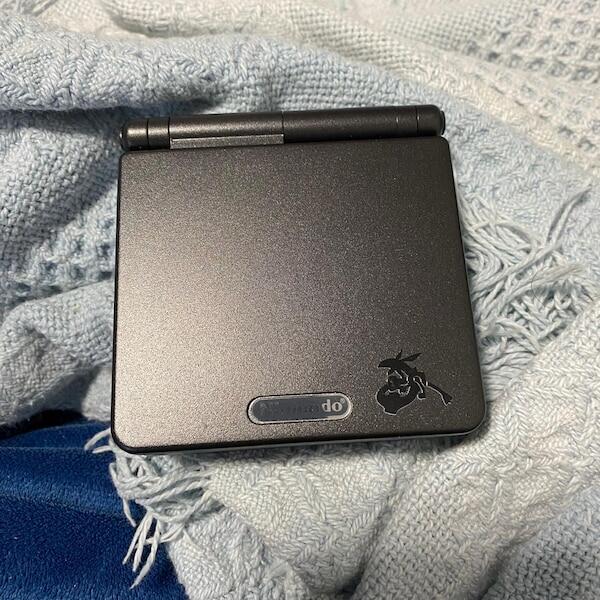

Four checks settle the question in under ten minutes: the screws holding the shell together, the charge port, the serial number under the battery cover, and what's stamped on the circuit board inside. A genuine Nintendo Game Boy Advance SP uses tri-wing (Gamebit) screws, a proprietary barrel-style charge port unless it's been modded, and a printed serial number sticker — clone shells and bootleg boards get at least one of these wrong.
- Tri-wing screws, a serial number sticker and Nintendo/Sharp chip markings are how to tell if a Game Boy Advance SP is genuine in 2026.
- USB-C charging on a GBA SP always means a mod, not a fake — Retrofit discloses every screen and port upgrade it sells.
- Opening the shell to read the PCB markings is the single most reliable authenticity check available to a buyer.
- The Nintendo Seal of Quality is embossed near the cartridge slot on every real AGS-001 and AGS-101 unit.
Why this matters
Nintendo stopped manufacturing the Game Boy Advance line years ago, and secondhand listings on Facebook Marketplace, eBay and Gumtree now mix genuine consoles with clone shells built around counterfeit boards. A clone board might boot a game, but it can misread save data, run hot, or die within weeks — and there's no Nintendo repair path for hardware Nintendo never made.
The checks below don't need a repair background. They need a small screwdriver, a flashlight, and two minutes with the battery cover off. Retrofit runs the same checks before any console goes out the door, whether it's a stock trade-in or a full IPS V5 rebuild.
How to tell if a Game Boy Advance SP is genuine
Work through these in order — each one takes seconds and rules out most fakes on its own.
- Check the screws. Genuine Nintendo shells use tri-wine (Gamebit) screws with a Y-shaped head, not standard Phillips. If a screwdriver from a normal home toolkit fits the shell screws, the shell has likely been opened and possibly replaced.
- Check the charge port. A stock 2003 or 2005 GBA SP charges through a proprietary barrel-style AC adapter port. USB-C or micro-USB on the same shell means the console has been modded — that's not automatically fake, but it's not stock either.
- Check the serial number. Every genuine unit has a printed serial sticker under the battery cover, in a consistent font and format. A missing sticker, a handwritten one, or mismatched printing is a warning sign.
- Check the screen. The original AGS-001 screen is reflective and needs external light; the AGS-101 has a brighter built-in backlight but still shows a visible pixel grid up close. A screen that looks unusually crisp or has a matte anti-glare finish is likely an aftermarket IPS panel.
- Open the shell and check the PCB. Genuine mainboards carry Nintendo and Sharp chip markings in a specific layout. Generic chip stampings, missing shielding, or a board that looks noticeably different from reference photos points to a clone.
- Check for the Nintendo Seal of Quality. It's embossed near the cartridge slot on every authentic unit. A blurry, crooked, or absent seal is one of the fastest tells.
If the charge port isn't the original barrel connector, you're not looking at a stock 2003 Nintendo Game Boy Advance SP — you're looking at a mod.
“If the charge port isn't the original barrel connector, you're not looking at a stock 2003 Nintendo Game Boy Advance SP — you're looking at a mod.”
Signs of a fake or clone GBA SP
A few red flags show up again and again on clone units listed as "genuine":
- Phillips-head screws instead of tri-wine Gamebit screws
- A USB-C or micro-USB port molded into an otherwise stock-looking shell with no visible rework around it
- A missing, crooked, or shallow Nintendo Seal of Quality near the cartridge slot
- A loose, rattly D-pad or shoulder buttons with inconsistent click resistance
- Generic chip markings on the mainboard instead of Nintendo or Sharp branding
- No serial number sticker, or a sticker in the wrong font under the battery cover
None of these on their own is conclusive, but two or more together is a strong signal the console isn't what the listing claims.
Secondhand sellers rarely disclose whether a console has been reshelled or reboarded, which is a separate risk from outright counterfeits — worth reading up on before buying from a marketplace listing rather than a seller who discloses mods upfront.
Buying a professionally refurbished unit removes most of this guesswork, since a genuine shell and mainboard get verified before any screen or port upgrade goes in. Retrofit's Stealth Black Edition starts from a checked, genuine Nintendo shell and mainboard, with disclosed IPS V5 and USB-C work and a 100 day warranty on top.


Does a genuine GBA SP have USB-C charging?
No — a stock Game Boy Advance SP from 2003 or 2005 charges through a proprietary barrel-style AC adapter, never USB-C. Any GBA SP charging over USB-C has had its charge circuit modded, which is a common and disclosed upgrade on refurbished units in 2026, not a sign of counterfeit hardware.
What is the Nintendo Seal of Quality on a GBA SP?
The Nintendo Seal of Quality is a small embossed logo near the cartridge slot that Nintendo stamped into every genuine console shell. A missing, faint, or crooked seal is one of the clearest signs a shell is a clone rather than original Nintendo hardware.
Can a bootleg GBA SP play genuine Pokémon cartridges?
A bootleg board can often power on and read a cartridge, but clone hardware is known in the retro community for save data errors and overheating during longer play sessions. That risk sits alongside a cosmetic clone shell, so a console can look right and still run on hardware Nintendo never built.
FAQ
How do I know if my Game Boy Advance SP is real?
Check for tri-wine (Gamebit) screws, a printed serial number under the battery cover, and Nintendo or Sharp chip markings on the mainboard once the shell is open. If any of those are missing or look off, the console is likely a clone rather than genuine Nintendo hardware.
What year did Nintendo release the GBA SP?
The original AGS-001 Game Boy Advance SP released in 2003, followed by the brighter-backlit AGS-101 model in 2005. Both are genuine Nintendo hardware and both are still tracked by collectors in 2026.
Is a modded GBA SP still a genuine Nintendo console?
Yes — a modded GBA SP keeps its original Nintendo shell and mainboard, with an aftermarket screen or USB-C charge port added on top. That's different from a clone console, which never had genuine Nintendo internals to begin with.
What screws does a real Nintendo GBA SP use?
A genuine GBA SP shell is held together with tri-wine (Gamebit) screws, which need a Y-shaped screwdriver bit rather than a standard Phillips head. Clone shells frequently use ordinary Phillips screws instead.
Where is the serial number on a GBA SP?
The serial number sticker sits under the battery cover on every genuine unit, printed in a consistent font and format. A missing sticker or an obviously different font is a red flag worth checking before buying.
Does a GBA SP screen look different if it's been modded?
Yes — a stock AGS-001 or AGS-101 screen is glossy and shows a visible pixel grid up close, while an aftermarket IPS panel looks sharper with a flatter, less reflective finish. Neither look makes the console fake, since the shell and board underneath can still be genuine Nintendo hardware.
Can a fake GBA SP damage my game cartridges?
A clone board reading a cartridge incorrectly can, in some cases, corrupt save data rather than damage the cartridge itself. It's a known risk with counterfeit boards and one more reason to check hardware before trusting it with original Pokémon or Zelda saves.
Is buying a secondhand GBA SP risky?
Buying secondhand carries some risk if the seller doesn't disclose mods or the console's history, since a reshelled or reboarded unit can look identical to stock in photos. Running through screw type, charge port and serial number checks before paying removes most of that risk.
One last thing
The single fastest tell most people skip is the charge port. If a listing photo shows a USB-C port on a shell claimed to be "all original," that's already a contradiction — Nintendo never shipped a GBA SP with USB-C, so it's either a disclosed mod or a mislabeled listing. Ask the seller directly which one it is before anything else on this list.