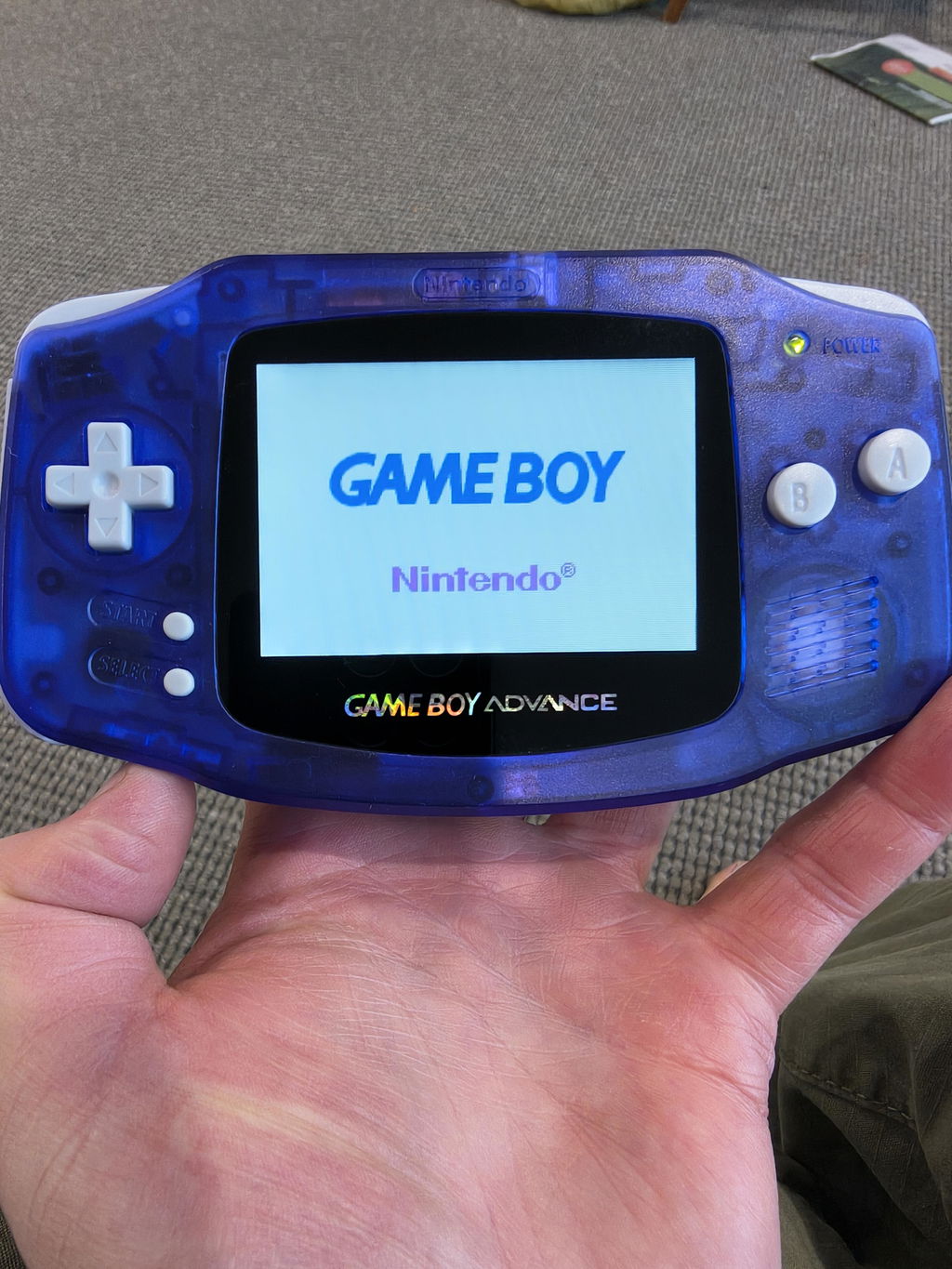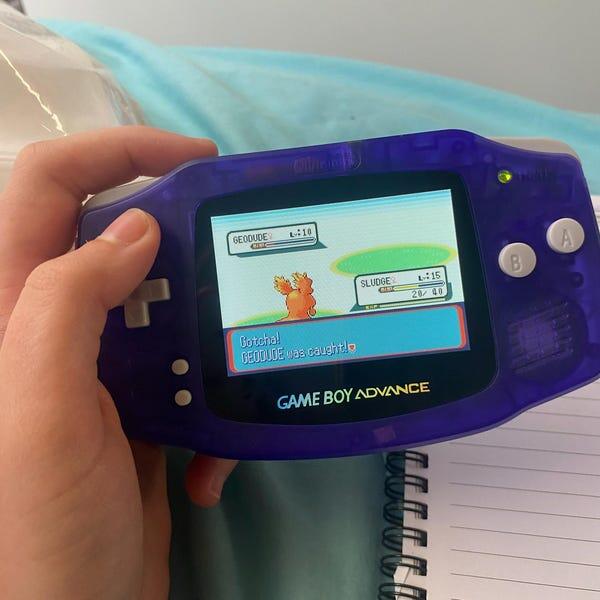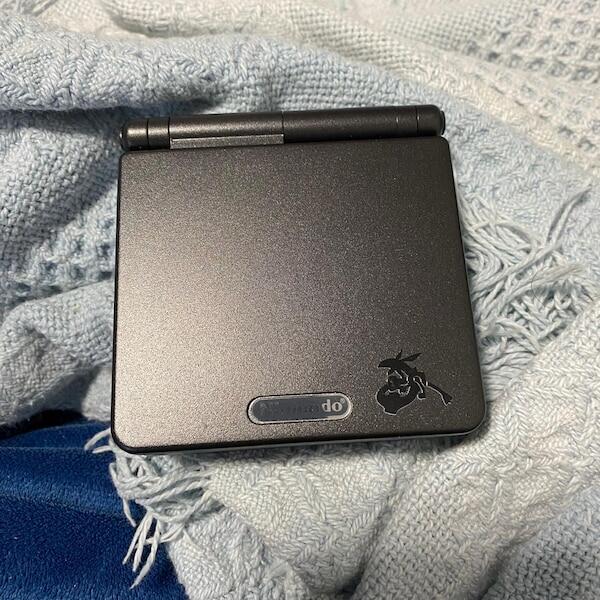

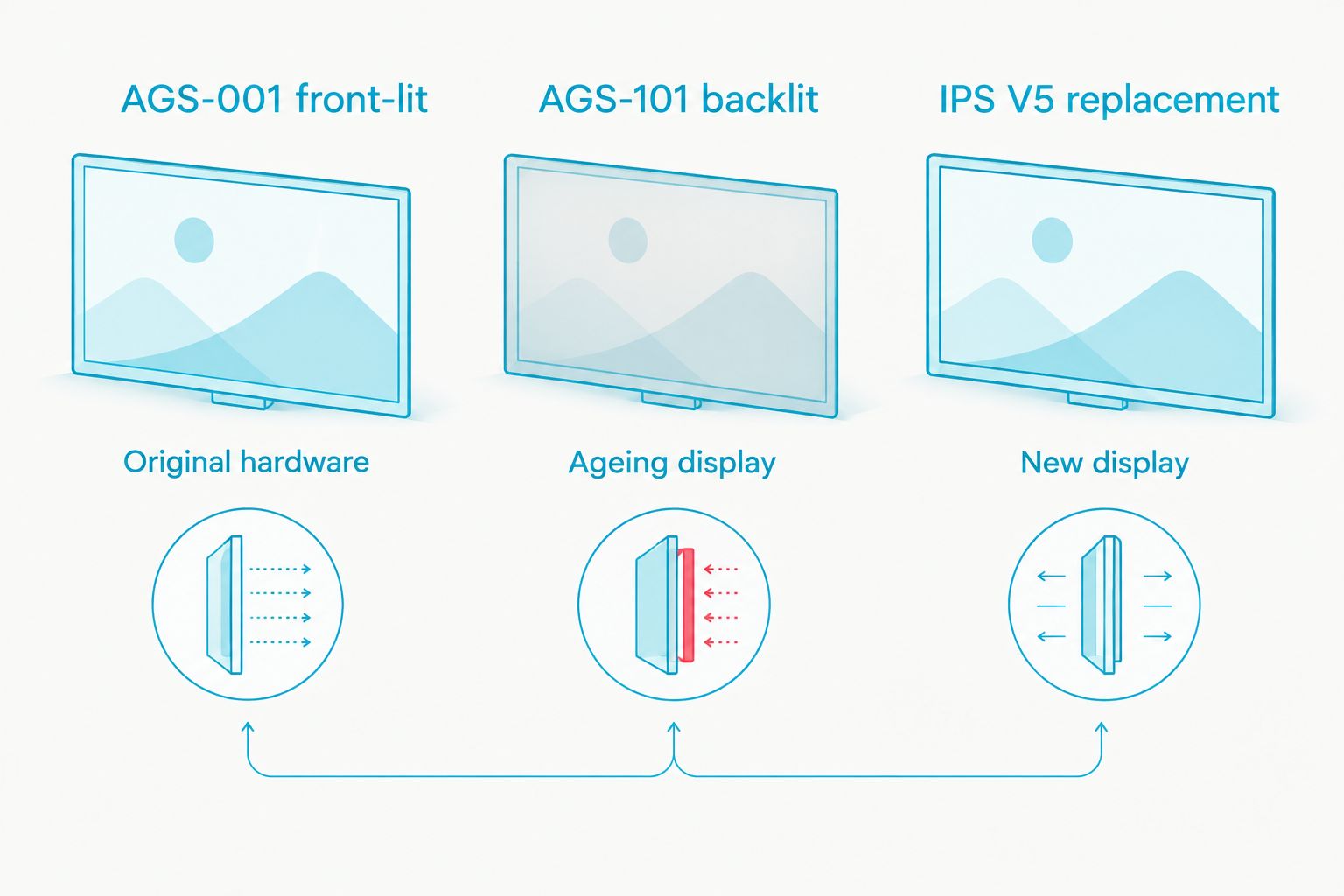
There is no verified universal hour rating for every IPS V5 screen, so an exact lifespan comparison with an original Game Boy Advance SP display is not defensible. In 2026, the useful comparison is age: an IPS V5 panel is new when installed, while original AGS-001 screens are up to 23 years old and AGS-101 screens are up to 21 years old. Installation quality, heat and ribbon-cable condition determine which display fails first.
- IPS V5 screen lifespan GBA SP estimates are unreliable without a panel-maker specification.
- An IPS V5 panel starts new; original AGS-001 screens are up to 23 years old in 2026.
- Original AGS-101 backlit screens are up to 21 years old in 2026.
- A new IPS panel has an age advantage, not a guaranteed durability advantage.
- Retrofit suits Australian players who want a professionally refurbished IPS V5 GBA SP rather than a DIY installation.
Why this matters
A screen can fail because of the LCD panel, frontlight or backlight, ribbon cable, connector, soldering or power circuit. Treating all of those faults as screen burnout leads to the wrong diagnosis and often the wrong repair.
The original GBA SP launched as the front-lit AGS-001 in 2003. The backlit AGS-101 revision followed in 2005, so surviving original displays already have more than two decades of material and electrical ageing behind them in 2026. A Transparent Black IPS V5 GBA SP uses a newer replacement display, but the motherboard and other original Nintendo components remain old hardware.
Retrofit is best for Australian players who want a professionally refurbished IPS V5 GBA SP without sourcing a panel, trimming a shell or completing the installation themselves. The trade-off is that a modified console is no longer an entirely original collector configuration.
How long does an IPS V5 screen last compared to the original GBA SP screen?
An IPS V5 screen has no single credible lifespan measured in hours because V5 is a kit designation rather than one universal panel specification. Different suppliers, control boards and installation methods sit behind the same broad label. Without a manufacturer datasheet for the exact panel, any precise hour figure is an estimate rather than a specification.
The original display has the opposite problem. Its remaining life cannot be calculated from its model number because storage conditions and previous use are unknown. In 2026, an AGS-001 display can be up to 23 years old, while an AGS-101 display can be up to 21 years old.
| Screen type | Original age in 2026 | Main advantage | Main disadvantage | Best for | Verdict |
|---|---|---|---|---|---|
| AGS-001 front-lit TFT LCD | Up to 23 years | Original hardware and lower modification risk | Dimmer image, narrow viewing angles and an ageing frontlight assembly | Collectors preserving an original console | Hold |
| AGS-101 backlit TFT LCD | Up to 21 years | Original Nintendo backlit display | Limited replacement supply and decades of existing age | Collectors prioritising an original backlit SP | Hold |
| IPS V5 replacement LCD | New when installed | Modern viewing angles, brightness control and fresh display hardware | Installation-dependent reliability and increased power demand at high brightness | Regular players who prioritise screen clarity | Buy for play; skip for an untouched collection |
The table does not prove that every IPS V5 panel will outlast every original display. It shows the defensible distinction: the replacement begins its service life at installation, while the original screen has already aged for 21 to 23 years.
IPS V5: no universal hour rating
IPS describes the liquid-crystal panel technology, while V5 identifies a generation of aftermarket GBA display kit. Neither term supplies an automatic lifespan figure. The control board, backlight assembly, ribbon cable and installation still determine how the complete modification performs.
That means a seller quoting a precise lifetime should also identify the panel manufacturer and the conditions behind the rating. A bare number without those details does not tell you how the screen behaves inside a folding handheld exposed to heat, movement and repeated opening.
An IPS LCD also is not an OLED panel. OLED burn-in discussions do not transfer directly to a GBA SP IPS modification. LCD systems can develop image retention, stuck pixels, uneven lighting or backlight faults, but permanent OLED-style pixel wear is not the primary comparison here.
Original AGS-001: up to 23 years old in 2026
The AGS-001 uses a front-lit TFT LCD rather than a modern IPS panel. Its light sits in front of the display, which contributes to its washed-out appearance and narrower viewing angles. A working AGS-001 screen can continue operating, but age leaves no reliable way to calculate its remaining service life.
Keeping the AGS-001 makes sense when originality matters more than brightness. Replacing it makes sense when the console is a daily gaming device and readability is the priority. For preservation, hold the original screen; for regular play, an IPS V5 upgrade is the clearer choice.
Original AGS-101: up to 21 years old in 2026
The AGS-101 uses a backlit TFT LCD and remains the strongest original Nintendo display option for the GBA SP. Its advantage is authenticity: the screen, display behaviour and power design belong to the factory configuration.
Its disadvantage is remaining life. A panel dating from 2005 has already experienced up to 21 years of ageing by 2026, even if it spent much of that time unused. Storage can slow visible wear, but it cannot make the ribbon cable, adhesive layers and electronic connections new again.
An AGS-101 also carries collector value that a screen modification can remove. If the original panel is clean and functional, preserve it rather than replacing it automatically. If the display has lines, flickering, major discolouration or connection faults, compare repair feasibility with a replacement instead of assuming the LCD itself is dead.
Why IPS V5 screen lifespan varies
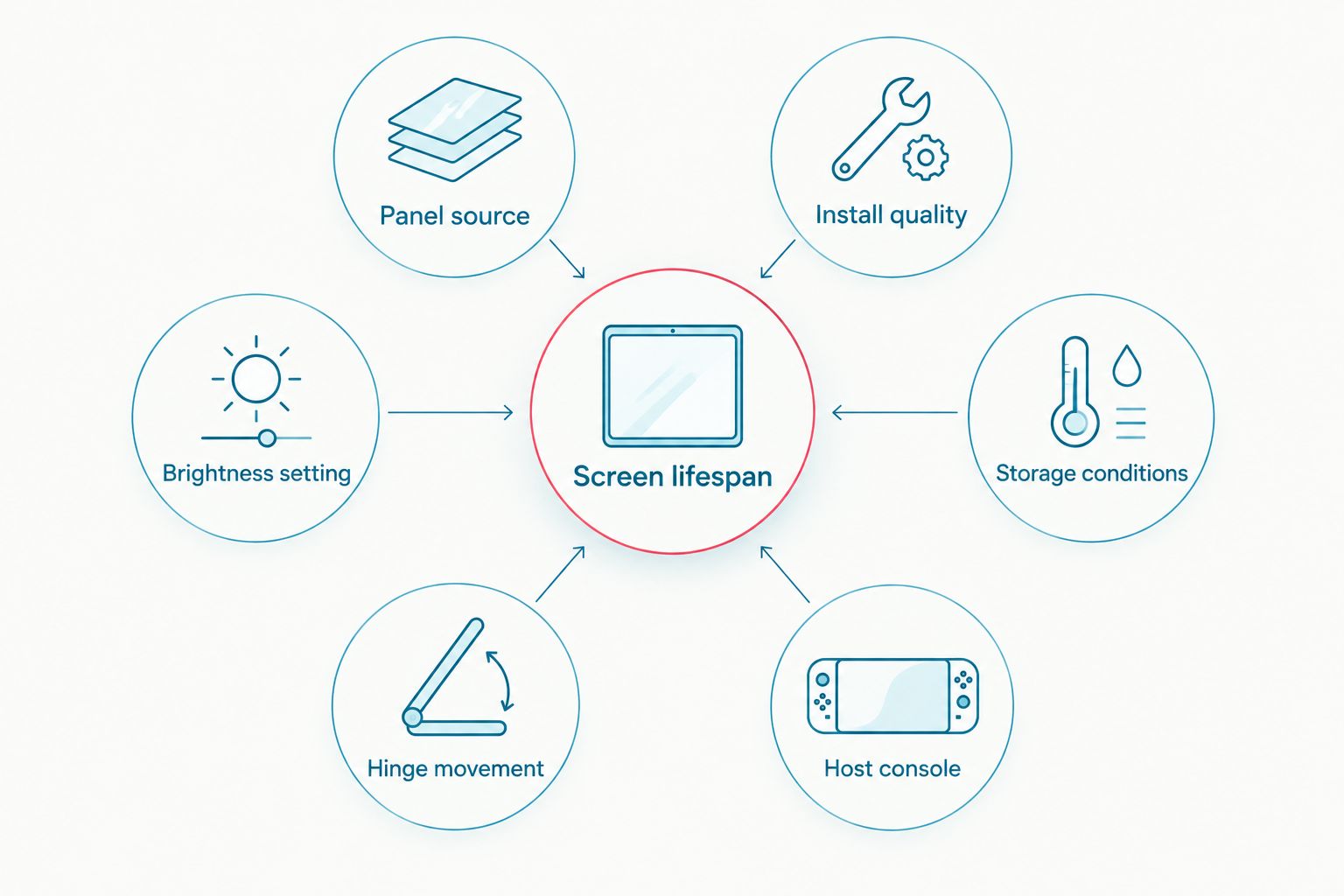
- Panel source: V5 does not identify one universal LCD manufacturer or one published service-life specification.
- Installation quality: A strained ribbon cable, poorly seated connector or weak solder joint can fail before the display panel does.
- Brightness setting: Higher brightness increases power demand and heat within the system, even though no exact lifespan reduction applies to every kit.
- Storage conditions: Heat, moisture and pressure affect LCD layers, connectors and electronics whether the screen is original or modified.
- Hinge movement: The GBA SP ribbon cable passes through a folding assembly, so routing and repeated opening matter to long-term reliability.
- Condition of the host console: A new display still depends on an old motherboard, power switch, battery connection and charging circuit.
These factors explain why a professionally completed installation matters more than an unsupported hour claim. Retrofit IPS V5 GBA SP consoles pair replacement displays with professionally refurbished hardware and proper testing, according to the brand description. The honest limitation remains: refurbishment does not make every original Nintendo component new.
For a wider kit comparison, the guide to Game Boy Advance IPS screen mods covers the choices that sit behind the finished console.
How to separate screen wear from another GBA SP fault
Start by checking whether the fault changes when you move the hinge. An image that cuts out or develops lines at certain angles points towards the ribbon cable, its routing or its connector. Do not keep flexing the hinge to reproduce the problem, because repeated movement can make cable damage worse.
Next, compare the display at several brightness levels. Flicker tied to one setting can indicate a control-board or power issue rather than general LCD wear. A completely dark image with working game audio can involve the lighting system, connection or power delivery; it does not automatically prove that the panel has failed.
Inspect the screen while the console is switched off. Cracks, pressure marks and dark liquid-crystal patches are physical panel damage. Dust or marks that remain sharply visible above the image can sit on the outer lens instead, which is separate from the LCD underneath.
Finally, check the battery and power behaviour. If the whole console resets, shuts down or loses audio with the image, diagnose power delivery before ordering a display. A screen-only fault and a system-wide power fault require different repairs.
Warning signs that need attention
- Vertical or horizontal lines that remain after the ribbon connection is checked
- Flickering linked to hinge movement
- Dark patches visible when the system is switched off
- Uneven lighting that changes independently of the game image
- A loose or damaged ribbon connector
- Heat, odour or visible damage around the display control board
Stop using the console if there is heat, odour or visible electrical damage. Continuing to power a damaged installation can turn a display repair into a motherboard repair.
Does an IPS V5 last longer than an AGS-101 screen?
An AGS-101 screen can be up to 21 years old in 2026, while an IPS V5 panel starts new when installed. That gives IPS V5 more remaining age on paper, but no universal hour specification proves that every IPS V5 panel lasts longer than every surviving AGS-101.
Can an original GBA SP screen outlast an IPS V5 replacement?
Yes. An original AGS-001 or AGS-101 can outlast a poorly manufactured panel or badly completed IPS installation. Age favours the new screen, while workmanship and component quality decide whether that advantage becomes real service life.
Does maximum brightness shorten IPS V5 lifespan?
Maximum brightness increases power demand and can increase heat, but there is no supported percentage or hour reduction that applies to every IPS V5 kit. Use the lowest comfortable brightness for the room; it reduces power demand without sacrificing visibility.
Which screen should you choose in 2026?
Choose an original AGS-001 screen when factory condition is the priority and you accept a dimmer front-lit image. Choose an original AGS-101 when you want Nintendo's backlit display and the existing panel remains clean, stable and functional.
Choose IPS V5 when the GBA SP is primarily for playing. You get a new display assembly, broader viewing angles and brightness control, but you also accept a non-original configuration and reliability that depends on the installation. Retrofit is the practical choice for an Australian buyer who wants a professionally refurbished IPS V5 console rather than a DIY screen project.
Choose a Retrofit IPS V5 build
Browse professionally refurbished and modded GBA and GBA SP consoles built in Australia.
FAQ
How long does an IPS V5 screen last on a GBA SP?
There is no verified universal hour rating for every IPS V5 GBA SP screen. Panel source, control-board quality, installation, brightness and storage conditions determine its service life.
Is an IPS V5 screen more durable than an original GBA SP screen?
An IPS V5 screen is newer, but newer does not guarantee greater durability. Original screens carry 21 to 23 years of age in 2026, while IPS reliability depends heavily on panel and installation quality.
How old is an original AGS-001 screen in 2026?
An original AGS-001 screen can be up to 23 years old in 2026 because the GBA SP launched in 2003. Its remaining life cannot be calculated from age alone.
How old is an original AGS-101 screen in 2026?
An original AGS-101 screen can be up to 21 years old in 2026 because that backlit revision dates from 2005. Storage and previous use determine its present condition.
Can an IPS V5 screen get burn-in?
An IPS V5 is an LCD rather than an OLED display, so OLED-style burn-in is not the primary wear mechanism. LCD image retention, stuck pixels, uneven lighting and backlight faults are separate issues.
Why does my GBA SP screen flicker when I move the hinge?
Flicker tied to hinge movement points towards the ribbon cable, cable routing or connector. Stop repeatedly flexing the hinge and have the connection inspected before the damage worsens.
Should I replace a working AGS-101 screen with IPS V5?
Keep a clean, working AGS-101 if originality and collector condition matter most. Choose IPS V5 if the console is primarily for regular play and modern screen clarity matters more than factory configuration.
Does an IPS screen reduce GBA SP battery runtime?
An IPS screen can increase power demand, particularly at high brightness, but runtime depends on the kit, battery condition and brightness setting. Shorter runtime per charge does not establish a shorter display lifespan.
One last thing
Take a clear photo of the working screen at your normal brightness in 2026. If brightness, colour or uniformity changes later, that baseline is more useful than trying to remember how the display looked months earlier. It also helps separate gradual display wear from a sudden cable or power fault.