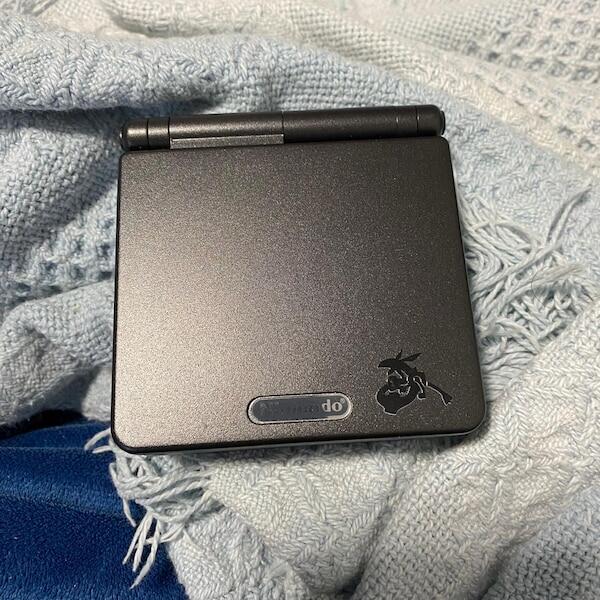

Best overall: a rigid case with a fitted padded insert. Best for daily commuting: a semi-rigid zip case with a separate accessory compartment. Best minimalist option: a soft sleeve inside a protected bag pocket. This 2026 guide ranks Game Boy Advance SP travel-case designs by their protective construction, not by claimed drop-test results.
- Gameboy advance sp travel case protection ranked: rigid fitted cases lead; soft sleeves mainly protect against scratches.
- Choose a semi-rigid zip case for commuting, with cables separated from the closed console.
- Retrofit Game Boy Advance SP owners should check their actual console’s fit rather than rely on compatibility labels.
- A hard exterior needs padded support, hinge clearance and a closure that does not squeeze the console.
Why this matters
The Game Boy Advance SP folds shut, but its clamshell does not replace a travel case. The outer shell, hinge and charging connection still need protection from loose objects and pressure inside your bag.
Retrofit sells refurbished and modded Game Boy Advance SP consoles. For a console with an upgraded display or charging connection, choose protection around the finished handheld—not around a generic description of the original model.
A rigid, padded case is the best travel-case design for Retrofit Game Boy Advance SP owners carrying their console in crowded luggage. Its value comes from combining an outer barrier with internal support; neither feature works well in isolation.
What makes the best Game Boy Advance SP travel case
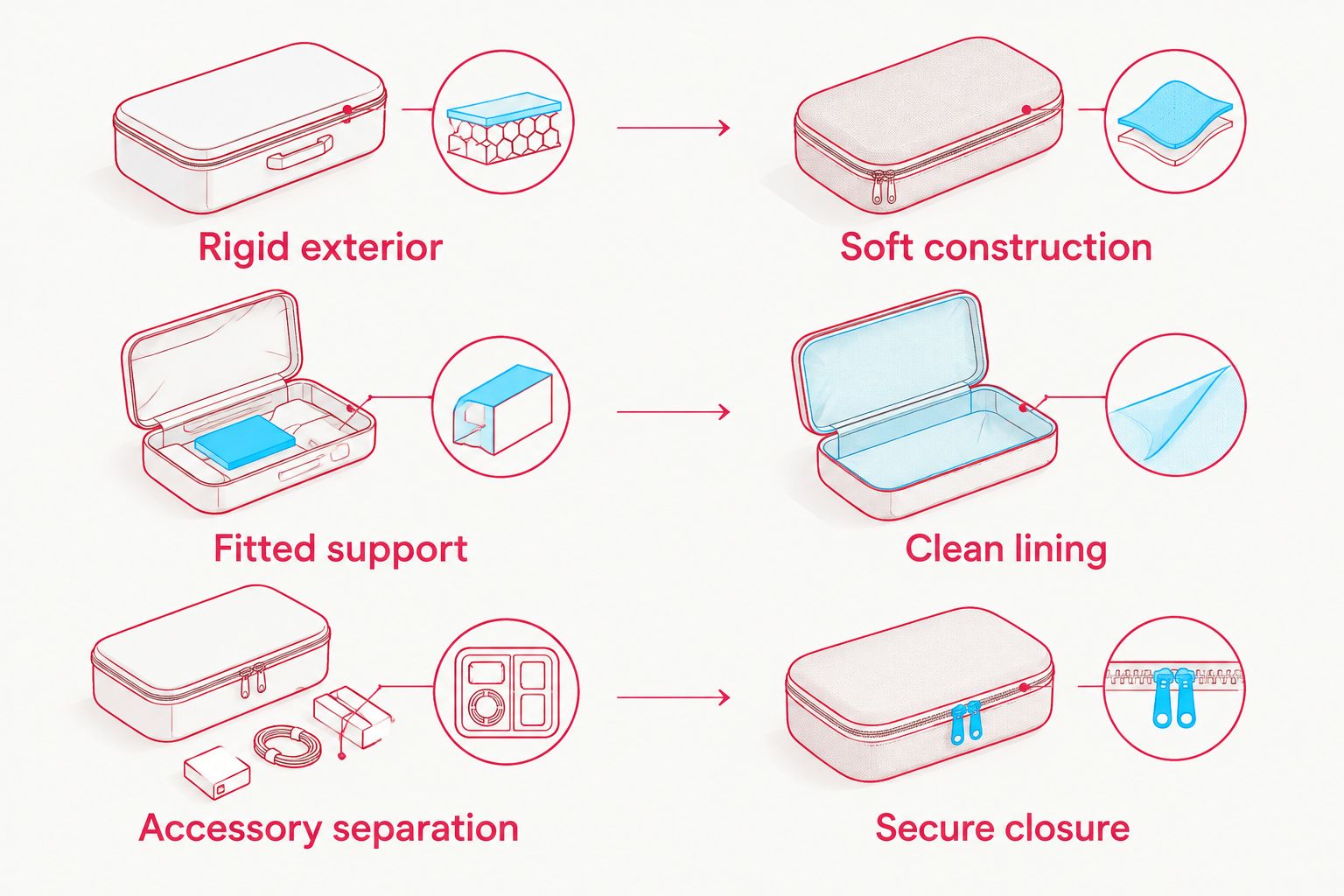
For this 2026 ranking, protective construction matters more than branding or decorative finishes. Assess these features before choosing a case:
- Pressure resistance: a rigid exterior creates a barrier between the console and surrounding luggage. A fabric sleeve does not provide equivalent structural support.
- Fitted support: padding should support the closed handheld without allowing it to slide around. A large empty compartment is not a protective fit.
- Hinge clearance: the hinge must sit clear of hard edges, closure hardware and tightly stretched fabric.
- Accessory separation: cables, adapters and cartridges need their own compartment or pouch. Nothing hard should press against the console lid.
- Clean lining: exposed seams, trapped grit and uncovered zipper hardware defeat scratch protection. Check the surfaces that actually touch the shell.
- Secure closure: the lid, zip or latch must close without forcing the console into position. Water resistance requires a separate, documented specification.
No single feature substitutes for the others. A rigid box with a loose handheld inside ranks below a properly fitted rigid case; extra padding cannot turn a soft pouch into a crush-resistant enclosure.
Travel-case protection at a glance
The order below assumes each case fits correctly and is in sound condition. These are construction categories, not ratings for particular manufacturers or guarantees against accidental damage.
| Rank | Case design | Best for | Standout protective feature | Key limitation |
|---|---|---|---|---|
| 1 | Rigid case with fitted padding | Crowded luggage | Structural exterior plus supported console compartment | Bulky; poor inserts leave movement or pressure points |
| 2 | Semi-rigid zip case | Daily commuting | Shaped enclosure with padded lining | Less structural support than a genuinely rigid case |
| 3 | Padded organiser pouch | Keeping a travel kit together | Divided storage for the console and accessories | Soft construction does not resist luggage compression |
| 4 | Soft sleeve | Scratch protection in a protected pocket | Close-fitting fabric barrier | Little structural protection against pressure |
The important distinction is structure versus surface protection. A sleeve separates the shell from nearby objects; a rigid case adds an outer structure, provided its internal fit supports the console properly.
1. Rigid padded case: best for crowded luggage
A rigid case places a structural enclosure around the closed SP. A fitted insert keeps the handheld supported and separates it from the enclosure’s hard surfaces. Choose this design when other belongings will share the same tightly packed bag.
The insert matters as much as the exterior. Reject a case that leaves the console rattling around, holds it against a hard latch, or requires pressure on the lid to close. A generic electronics box only becomes suitable when its internal arrangement fits your handheld.
Rigid padded case pros:
- Structural walls separate the console from surrounding objects.
- A fitted insert limits movement within the compartment.
- Dedicated accessory spaces keep hard items away from the shell.
Rigid padded case cons:
- Takes more bag space than a sleeve or soft pouch.
- An unsuitable insert creates pressure points or leaves excess movement.
- A hard exterior alone establishes neither waterproofing nor a drop rating.
Best for: flights, road trips and bags packed with other equipment.
Verdict: Buy a rigid padded case when pressure from surrounding luggage is your main concern. Check the insert before trusting the exterior.
2. Semi-rigid zip case: best for daily commuting
A semi-rigid case combines a shaped outer body with a fabric lining and zip closure. It gives you a defined compartment without the bulk of a larger rigid box. Choose a version with a divider that keeps accessories away from the console.
Construction varies within this category. Inspect whether the lid bends inward towards the handheld, whether the lining covers the zip track, and whether the console stays in position when carried. A shaped outline alone does not establish protective performance.
Semi-rigid zip case pros:
- Shaped walls keep the console separate from loose bag contents.
- A padded lining provides a barrier against rubbing.
- A divided layout keeps everyday accessories organised.
Semi-rigid zip case cons:
- Flexible walls provide less structural support than rigid walls.
- An overloaded accessory pocket can press against the lid.
- A standard zip is not evidence of water resistance.
Best for: commuting with the case in a dedicated backpack compartment.
Verdict: Buy a semi-rigid zip case for everyday carry when the fit is secure and the accessory compartment closes without pressure.
3. Padded organiser pouch: best for keeping a travel kit together
A padded organiser pouch stores the closed console alongside separately retained accessories. Its main advantage is organisation: you can remove the whole kit without searching through your bag. Padding separates the shell from surrounding items, but the pouch remains flexible.
Choose partitions that keep their contents in place. An open pocket above the console is not useful separation if a cable connector escapes when the pouch turns upside down. Pack each compartment according to its actual space, not the number of pockets advertised.
Padded organiser pouch pros:
- Holds the handheld and accessories in a single organised kit.
- Fabric partitions separate items without rigid internal walls.
- Flexible construction fits around other bag contents.
Padded organiser pouch cons:
- Does not provide a structural barrier against luggage compression.
- Loose pocket contents can migrate into the console compartment.
- Overpacking removes the clearance that padding needs.
Best for: carrying an organised kit inside a bag that already provides a protected compartment.
Verdict: Hold unless your outer bag keeps pressure off the pouch. Organisation is useful, but it is not equivalent to rigid protection.
4. Soft sleeve: best for scratch protection in a protected pocket
A soft sleeve wraps the closed SP in fabric, keeping its shell separate from nearby surfaces. It is the simplest option when you already have a dedicated pocket and do not need accessory storage. Choose a clean lining with no exposed abrasive seams.
A sleeve is not a complete answer for a crowded backpack. Keys, chargers and bottles belong elsewhere, and the sleeved console should not sit beneath heavy items. Its role is to provide a surface barrier, not to carry external loads.
Soft sleeve pros:
- Adds little bulk around the folded handheld.
- Separates the shell from pocket lining and nearby surfaces.
- Keeps the packing arrangement simple when accessories travel separately.
Soft sleeve cons:
- Provides little structural support against pressure.
- An open mouth leaves part of the console exposed.
- Grit trapped in the lining can rub against the shell.
Best for: a dedicated, protected pocket with no loose hard objects.
Verdict: Skip as your only protection in crowded luggage. Use a sleeve for controlled everyday carry, not as a substitute for a rigid case.
Check the fit before your first trip
Nintendo’s published dimensions for the original folded Game Boy Advance SP are 84.6 mm × 82 mm × 24.3 mm. Use those measurements as a reference, not as proof that a case will fit your particular handheld. Internal seams, padding and closure hardware all occupy space.
For a refurbished or modified console, measure the finished unit and inspect any external changes. Retrofit Game Boy Advance SP consoles include refurbished and modded options; a screen or charging upgrade does not establish case compatibility by itself.
Work through these checks for your 2026 travel setup:
- Measure the console. Check the folded handheld’s outside dimensions, including anything that projects beyond the shell.
- Check the lining. Remove grit and inspect seams, zip hardware and hard internal edges.
- Check the hinge. Place the console inside without wedging the hinge against a wall or divider.
- Separate accessories. Put cables and cartridges in retained compartments, not loose above the lid.
- Close gently. Stop if the closure requires squeezing the console or compressing accessories against it.
- Check movement. Gently tilt the closed case; revise the fit if the handheld shifts against hard surfaces.
Do not add random padding until the case becomes difficult to close. Support should hold the console in place without preloading the lid. If the hinge already feels loose or the shell is cracked, read the guide to repairing a broken Game Boy Advance SP hinge before relying on a case to manage that damage.
Pack the console and charging gear separately
Disconnect charging cables and external adapters before putting the SP away. A protruding connector creates an awkward packing point and leaves the port exposed to force from surrounding objects. Coil the cable in its own retained compartment.
Keep the console switched off and folded closed for transport. Put the case where you can retrieve it without dragging it through loose objects, and keep liquids in a separate compartment. A case is a protective layer, not permission to pack the handheld underneath heavy equipment.
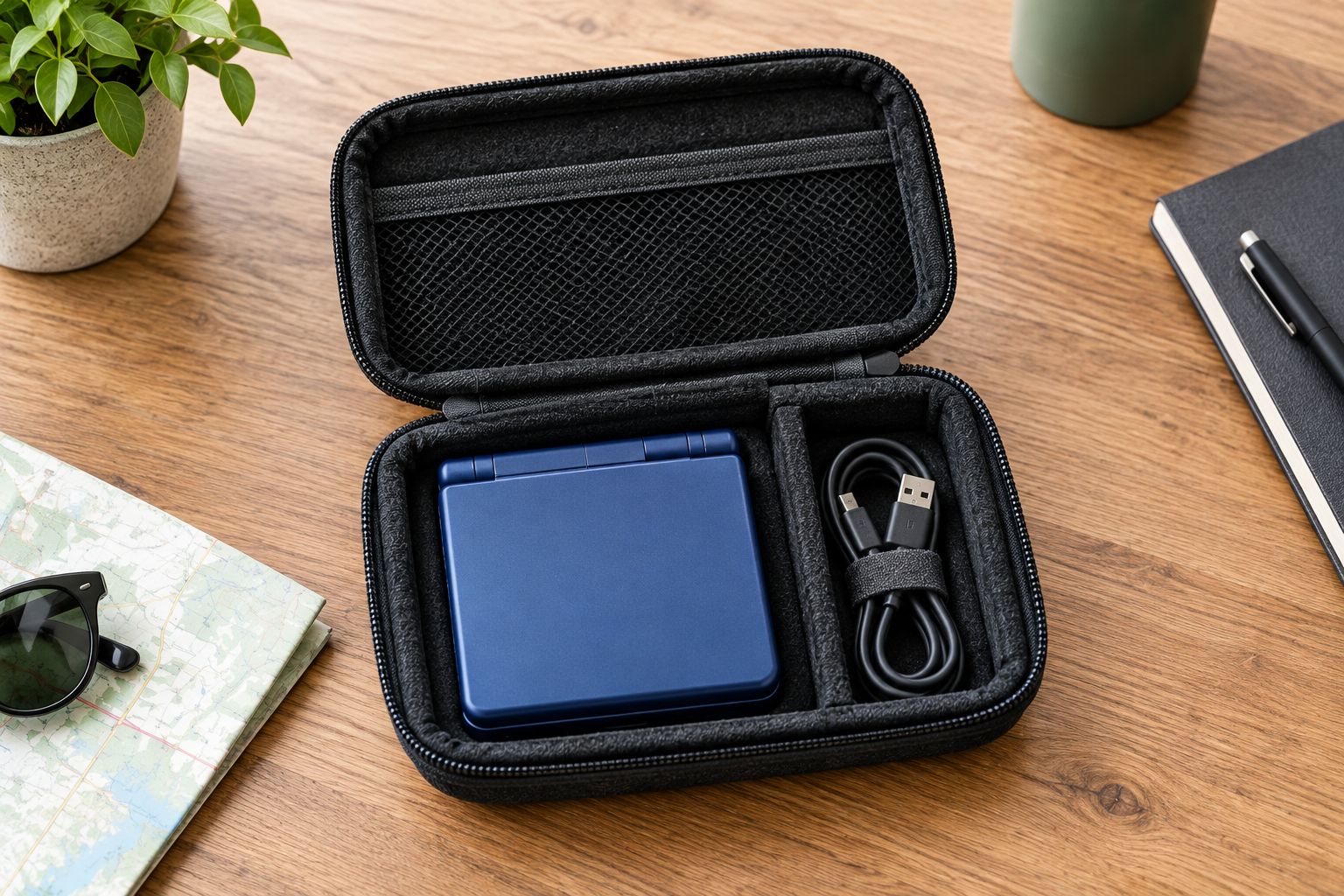
Before leaving in 2026, inspect the case as well as the console. Check the lining for grit, the zip for trapped fabric and any removable divider for movement. Replace or repair a closure that no longer keeps the compartment shut; adding another pouch does not fix a failed latch.
How the protection ranking works
This 2026 ranking prioritises structural resistance to surrounding pressure, then fitted support, hinge clearance, accessory separation and clean contact surfaces. The rigid padded case leads because it combines an outer structure with internal support. The sleeve finishes last because its strength is surface separation rather than structural protection.
This is a design-based buying guide, not a measured drop-test leaderboard. Do not translate the ranking into a safe drop height, a waterproof rating or a guarantee against damage. Those claims require evidence for the exact case and its intended use.
Which Game Boy Advance SP travel case should you choose?
Choose a rigid case with fitted padding if you are undecided. It is the default for a console sharing luggage with other belongings. Choose a semi-rigid zip case instead when everyday portability matters and your bag provides a dedicated compartment.
A padded organiser earns its place when keeping accessories together is the priority. A soft sleeve suits a protected pocket. In every category, reject poor fit: the right construction with the wrong internal layout is still the wrong case.
FAQ
What’s the best Game Boy Advance SP travel case for protection?
A rigid case with fitted padding is the best default for crowded luggage. It combines a structural exterior with internal support, provided the hinge has clearance and accessories stay separate.
Is a hard case better than a soft sleeve for a GBA SP?
A properly fitted rigid case provides more structural protection than a soft sleeve. A sleeve mainly separates the shell from nearby surfaces and belongs in a protected pocket.
What size case does a Game Boy Advance SP need?
The original folded Game Boy Advance SP measures 84.6 mm × 82 mm × 24.3 mm according to Nintendo’s published specifications. Measure your actual console and check usable internal space, including padding and seams.
Will a travel case fit a modded Game Boy Advance SP?
Compatibility depends on the finished console’s dimensions and external fittings. For a Retrofit Game Boy Advance SP, check the actual handheld rather than assume that a generic SP compatibility label guarantees clearance.
Can I keep the charger in the same case as the console?
Keep charging gear in the same case only when a retained compartment separates it from the handheld. Disconnect the cable before packing, and do not place connectors against the lid or hinge.
Does a zipped Game Boy Advance SP case keep water out?
A zip closure alone does not establish water resistance. Rely on a documented specification for the exact case, and keep drinks separate from the console.
Does the SP’s folding screen mean it doesn’t need a case?
The folding screen does not protect the whole console from loose objects or luggage pressure. The outer shell, hinge and charging connection still need a suitable packing arrangement.
One last thing
A case can create the pressure you bought it to prevent. An overfilled accessory pocket or overly tight insert presses inward before the bag even moves. For your 2026 travel kit, make effortless closure the final check: if you must squeeze it shut, change the packing arrangement or choose a different case.